
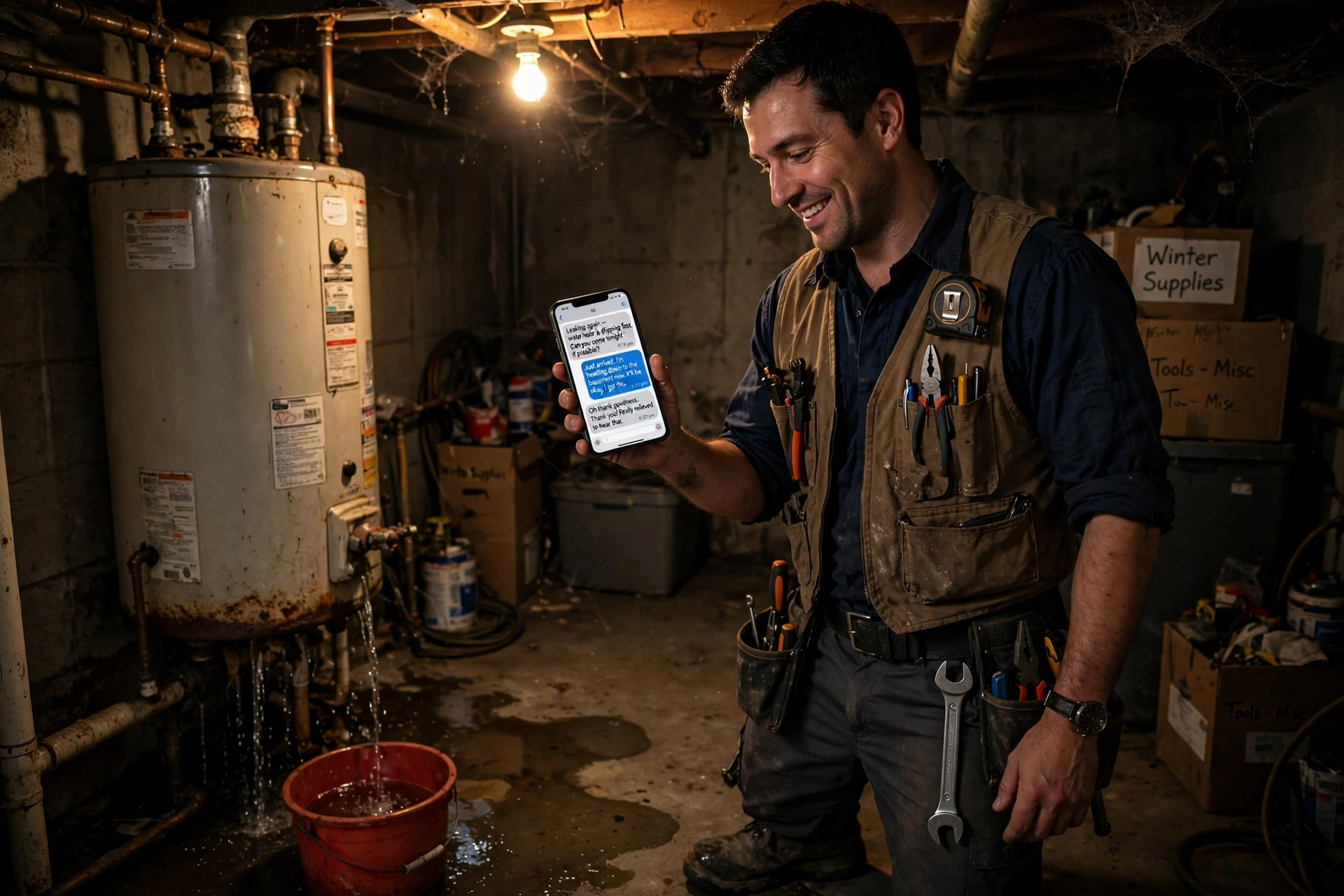
It's 9:20 on a Tuesday night. A homeowner is standing in a puddle in front of a leaking water heater, calling the first plumbing shop on the list. That shop is yours, and nobody picks up. If you're wondering how to answer business calls after hours without chaining yourself to the phone, that 9:20 call is the whole problem — because that homeowner does not leave a voicemail and wait. They call the next name on the list.
What Actually Happens to After-Hours Calls
After-hours callers are not browsers. People ring a salon at 8 p.m. because they want the Saturday slot before someone else takes it. They ring a plumber at night because something is leaking, broken, or cold. These are the highest-intent calls a small business gets — and they land exactly when the shop can't answer.
The usual fixes each break somewhere. Letting it ring out means the caller moves on within the minute. Voicemail sounds like a safety net, but most people who reach a recording after hours hang up and dial the next business — the message you find in the morning is the exception, not the rule. Forwarding the shop line to your personal cell works until it doesn't: you answer at dinner, at your kid's game, at 11 p.m., and within a month you either burn out or start letting it ring — the original problem in a different coat. A staffed answering service solves the hours but puts a stranger with a script between you and your customers.
What the after-hours caller actually needs is simple: a fast response, in your business's name, with a clear next step.
How to Answer Business Calls After Hours With The Mayor
The Mayor is built around one loop: a missed call becomes a text-back, and the text-back becomes a booking. After hours, that loop runs the same as it does at noon. Here's how it works, step by step.
You connect your own business number. The Mayor works through a number you own, connected through Telnyx or Twilio. Once a Telnyx number is connected, text-backs send automatically from that number; Twilio numbers connect for voice calls, and automatic text-backs are sent through Telnyx. Calls, texts, and your number run through your own provider account — billed directly at its own rates, separate from your Mayor plan and never marked up.
Every unanswered call gets an instant text-back, in your voice. The wording is written for your trade. The plumbing version on the site reads: "Hi, this is your business. Sorry we missed your call! Is this urgent? Reply YES and we will get you scheduled right away. Reply STOP to opt out." A salon's version asks about an appointment; a restaurant's, about a table.
The reply leads somewhere. When the caller replies YES, The Mayor follows up with your open times and works toward a booked appointment — for an urgent plumbing call, it flags the job as urgent so it lands on tomorrow's board before you wake up.
You see the night's work in the morning. The Mayor opens your day with a briefing: who is coming in, what is still open, and what came in overnight — as bookings and next steps.
You set it up by talking, not by configuring. You sign in, tell The Mayor about your business, and confirm your services, opening hours, and booking rules in conversation, and connect a calendar in the Connectors section. Your hours define when the shop counts as closed; your booking rules define what can be offered at 9:20 p.m.
What does it cost to run the night shift this way? Every business starts free — no credit card to start. The free plan includes 100 reply attempts a month (roughly 10 real conversations) and 10 microphone minutes a month. Pro is $99 a month: 1,000 reply attempts (roughly 100 real conversations) and 120 microphone minutes. Every try counts toward your allowance, not only delivered replies. Your provider bill is separate: the site's worked example, on Telnyx's published US rates checked in October 2026, puts a month of 100 answered calls, 40 call-backs, and 150 text-backs at about $4.50, billed by Telnyx to your own account. One-time top-ups run $4, $8, and $12. The full breakdown is on the pricing page.
A Worked Example: One Night at a Two-Truck Plumbing Shop
This is an example, not a customer story — the after-hours flow walked through end to end.
The shop closes at 6. At 7:15, a regular calls to move Thursday's drain job because her in-laws are arriving early. Nobody answers; she gets the text-back within moments, replies YES, picks a new time from the open slots The Mayor offers, and the job moves on the book — no phone tag the next morning.
At 9:20, the water heater call comes in. The text-back asks if it's urgent. The homeowner replies YES, The Mayor treats it as urgent, and the job is on tomorrow's board before the owner is awake.
At 6:45 the next morning, the owner opens The Mayor and gets the briefing: the drain job moved, the water heater is first on the board, and one more overnight call — a question about a quote — waits as a draft follow-up. Three after-hours calls, three outcomes, zero rings at the dinner table. The mechanism is the same missed-call text-back that runs during the day; after hours is where it earns the most, because the alternative was silence. It's the same leak the first article in this series priced out — what a missed call actually costs a small business.

Who This Is For — and Who It Isn't
It's for you if you run a local business where after-hours calls mean real work: plumbing and HVAC, salons and barbershops, restaurants, dental and med spa offices, auto repair, pet grooming. If your customers book and schedule when they're off work — which is when you're off too — a text-back in your name is the difference between a booking and a dial tone.
It's not for you if you already staff a phone around the clock, if your callers need a long live conversation before anything can be booked, or if your customers can't or won't text — the loop is built on text-back. And true emergencies belong on 911, not a shop line.
Questions Owners Ask
Does The Mayor answer the call live, or text back?
Once your number is connected through Telnyx, every unanswered call gets an instant text-back from your number, automatically. Twilio numbers connect for voice calls; automatic text-backs send through Telnyx. Until a number is connected, The Mayor drafts the messages for you to send yourself.
What does the free plan actually include?
$0, no credit card to start: 100 reply attempts a month — roughly 10 real conversations, figuring about 10 replies each — plus 10 microphone minutes a month. Pro, at $99 a month, raises that to 1,000 reply attempts (roughly 100 conversations) and 120 microphone minutes.
What do I pay my phone provider on top of that?
Calls, texts, and your number run through your own Telnyx or Twilio account, billed at the provider's own rates, never marked up. The site's worked example on Telnyx's published US rates (checked October 2026) totals about $4.50 for a month of 100 answered calls, 40 call-backs, and 150 text-backs.
Can a caller opt out of the texts?
Yes — the text-back wording includes "Reply STOP to opt out," and the sample wording on the site is the real template with your business name and trade wording swapped in.
How long does setup take?
Minutes, per the site: sign in, tell The Mayor about your business, confirm your services, hours, and booking rules in conversation, connect your calendar, and connect your number.
Put Tonight's Calls to Work
Your next after-hours call is coming whether you're ready or not — tonight, probably, while you're eating dinner. The caller can keep getting silence, or they can get a text-back in your name with a path to a booking. Start free with The Mayor — no credit card, and the free plan's 100 reply attempts are enough to watch the loop work on your own book before you spend a dollar.
Related reading: Missed Call Text Back for Small Business: How It Actually Works — what fires the second a call goes unanswered, what the text says word for word, and what it costs.